

Perspective
Reflections on strategy, my work, and the nonprofit industrial complex

The water we swim in
I’ve been thinking about the proverb that states that the last to know about water is the fish, meaning it can be hard to critically examine “the water we swim in” when it is all that we know.
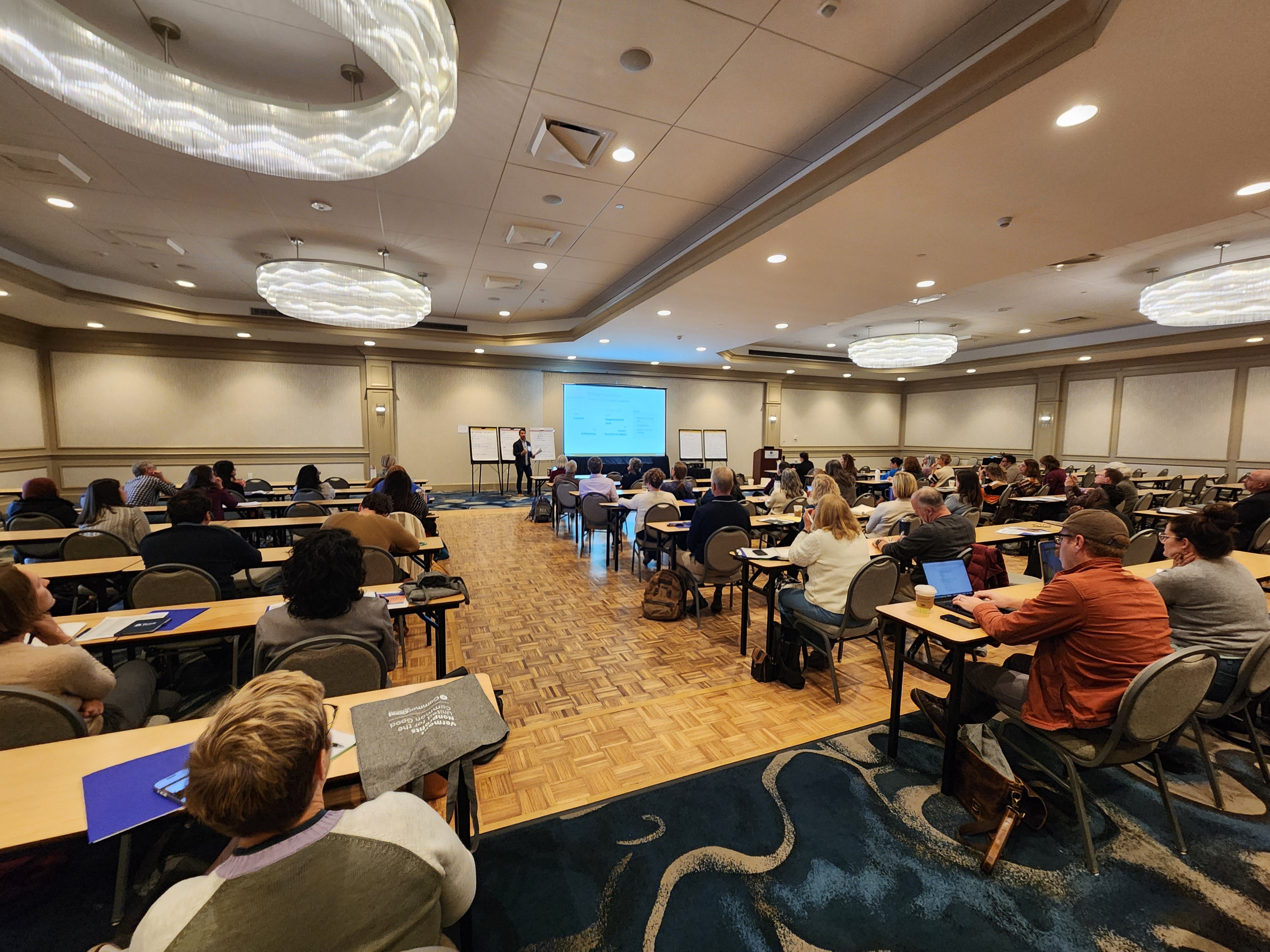
Earlier this month, I alluded to this perspective in a conference session in which I spoke to nonprofit leaders, board members, and funders about strategy for complex and uncertain times. The slide that sparked the most energy in the room described rough eras in the evolution of mainstream management approaches and how those mindsets and methodologies made their way into the social sector with the rise of the Nonprofit Industrial Complex (NPIC).
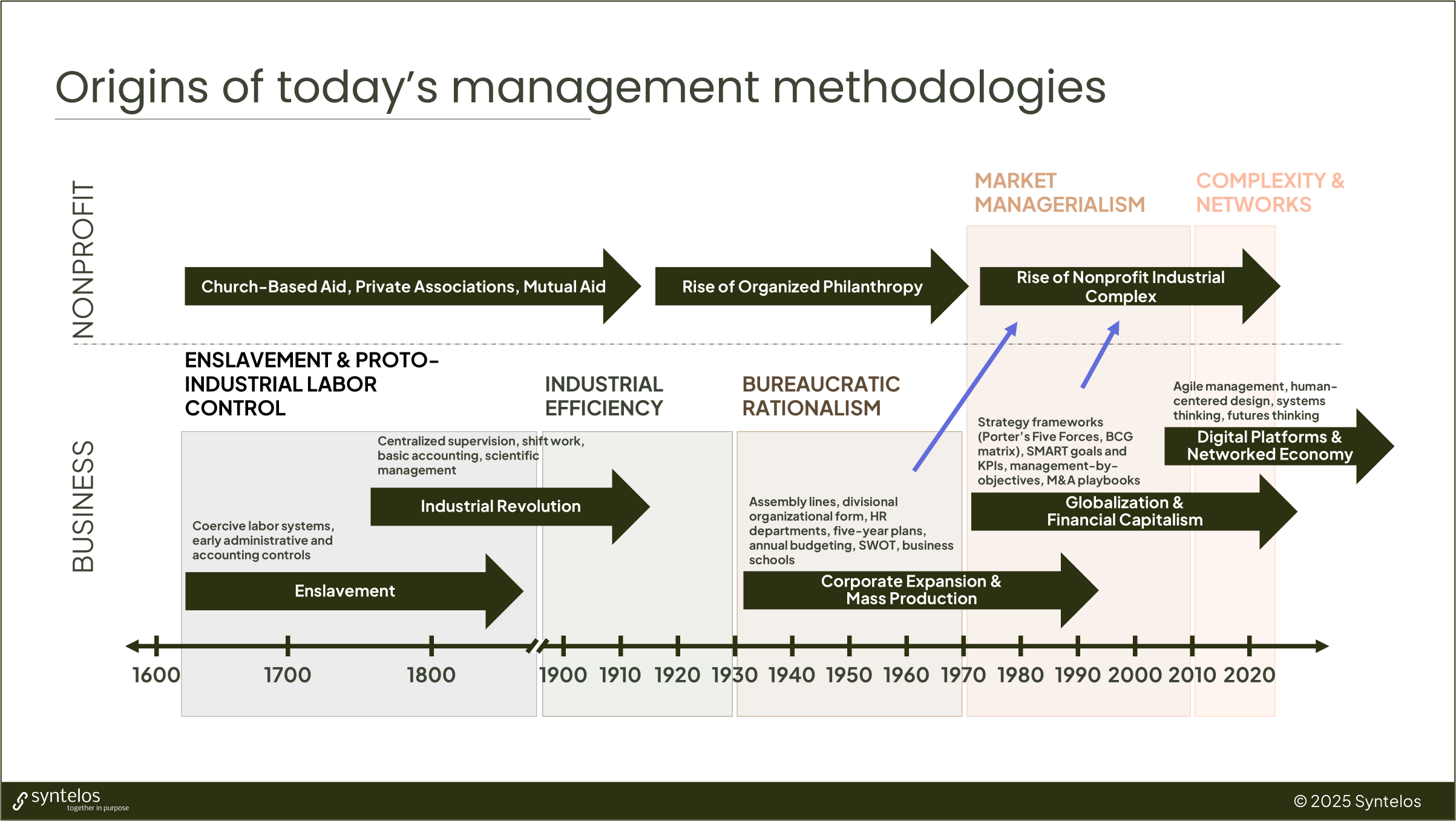
The slide charts the progression from modern management’s origins in slavery and early industrial labor management (1600s through 1800s); through management eras focused on industrial efficiency (early 1900s); then bureaucratic rationalism (roughly 1930 to 1970); then the market managerialism of neoliberal capitalism (1970s - modern times); and finally into increasing application of complexity science in mainstream practices (since roughly the 2010s).
As the NPIC grew along with neoliberalism, we adopted the dominant private sector management methodologies of the times, including: the divisional organizational form, five-year plans, SWOT, the BCG matrix, and management by KPIs.
But these tools were built for a more stable context, in a time before complexity science informed management practice, and under a paradigm in which people were seen as resources to be used (up).
When applied uncritically in mission-driven organizations—especially those seeking systems change—they can undermine the mission.
In fact, I believe we’re living in a period in which our survival as a civilization relies on the collective project of reimagining these operating principles and others we’ve relied on for the last 400 years.
Yet, for those of us working in social and environmental justice today, generally having entered the workforce after the 1970s, they are the water we swim in. For most, this is the only organizational and management paradigm we have ever known. It often goes unexamined. And even when it is, it’s far from clear how to start getting the job done differently when we’ve inherited institutions built in the old paradigm.
I do see this beginning to change. Theorists and practitioners are rethinking the premises of our organizations, institutions, and more generally how we exist, strive, and become together as whole, inherently valuable humans. I’ll expand on this more in another newsletter, but see for example the work of Indy Johar and Pieter de Beer.
That is also how I’ve come to see my own purpose in my writing and consulting. Co-creating with so many others on the journey, I hope to help discover how we can build toward the new paradigm even from within our current organizations and institutions. Adopting this perspective has given me great clarity amidst the noise.
Entangled planes
This year, I have had the privilege of responding to Nonprofit Quarterly reader questions about strategy. A couple of weeks ago, I had the opportunity to explore how to reconcile our dreams of what could be with the present realities of what we’re comfortable committing to in strategy.
The reader’s question alluded to the fact that the two orientations (what could be and what we’re comfortable committing to) can seem to be paradoxical: some strategy processes manage only to choose one orientation or the other, remaining lost in visioning or becoming captured by organizational inertia. Others unhelpfully conflate the two, setting a big, hairy, audacious goal and then making an entirely unrealistic multi-year plan to get there.
I believe the apparent polarities can be reconciled. It comes down to perspective.
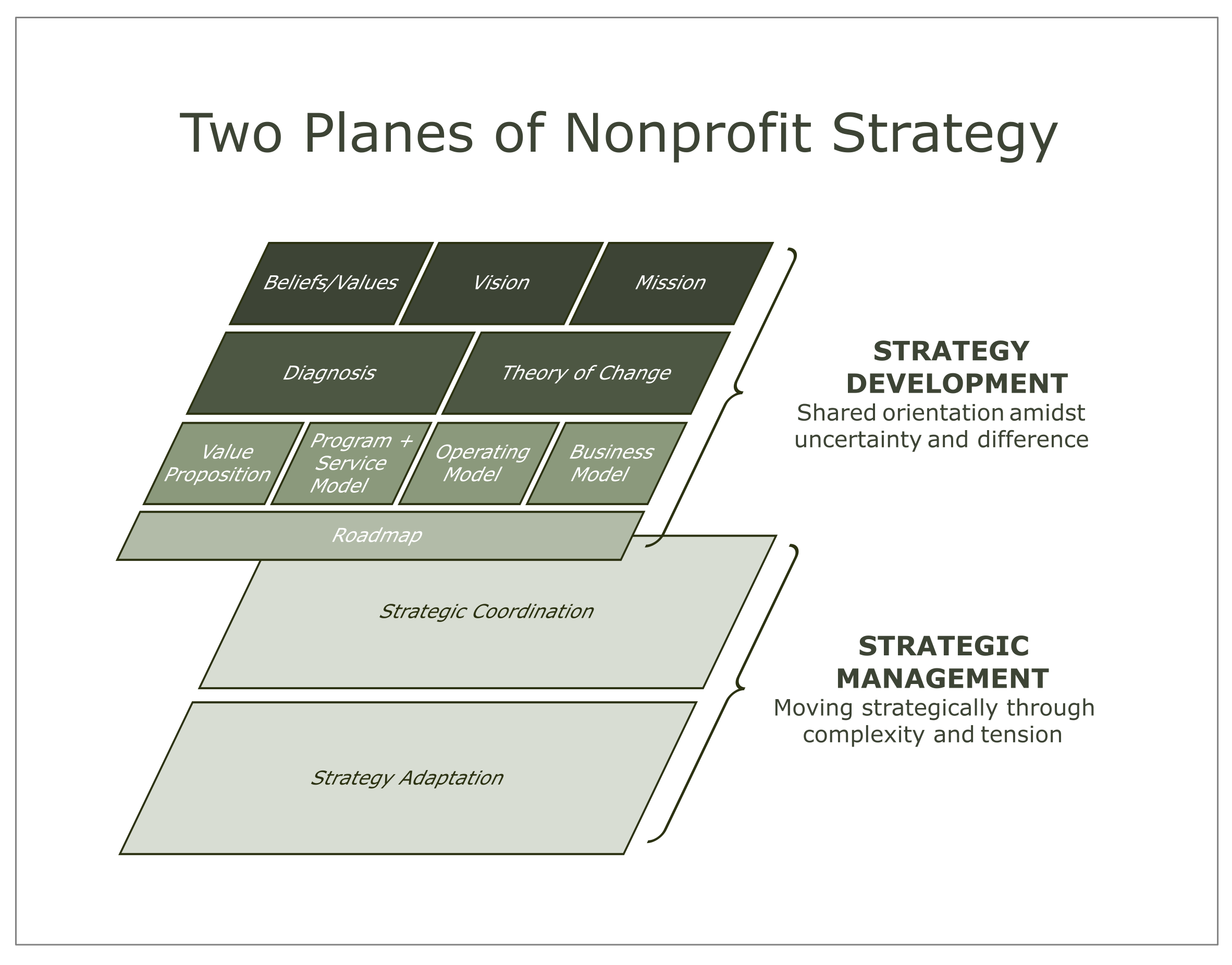
I have come to think of the two orientations as living in separate but entangled planes of organizational strategic life. One plane contains the “future-back” work of aligning on strategic intent amid uncertainty and difference. The other contains the “present-forward” work of moving strategically toward that intent through complexity and tension.
Both planes, together, constitute strategy. I believe strategy works best when leaders and organizations learn to operate fluidly between the two.
For more, see “Reconciling Future-Back and Present-Forward in Strategy” in Nonprofit Quarterly.
A journey and a dialogue
The way I see it, we’re all journeying here. Many of us are becoming companions on a journey into the new world, walking together, thinking, experimenting, and sharing what we learn.
This year, I leaned into this perspective, and I’m glad I did. I cold-contacted people whose thinking I respect, and this has turned into many a lovely conversation and relationship. I focused my consulting with leaders and organizations who are building what comes next, and I have felt at home in this work. I began sharing what I’m learning through my writing, and found even more people who, like me, are hungry for management practices that feel more like the world we want and deserve.
I’ve found that I like journeying this way. If you share a similar perspective, I’d love for our paths to cross.
👋🏽 Hi, I’m Nick.
If you’re new to this newsletter, here’s a little bit about me:
I’m helping nonprofit organizations meet this moment strategically, via clarity and empowerment rather than quantification and control.
I write to share my learnings about how we can build toward a new world even when we’ve inherited organizations and institutions that come from the dominant paradigm.
I also partner with nonprofit leaders who are dissatisfied with the conventional approaches to strategy. They’re curious about how to structure their organization and manage strategically toward systems change in a complex and uncertain environment.
If that sounds like you, let’s connect! You can also learn more at www.syntelos.co.
In purpose,
Nick